Managed Service Provider vs Outsourcing: Key Differences & Benefits


Managed service providers help organizations run, monitor, support, and improve business technology without carrying every responsibility in-house. For many companies, the real decision is not simply whether to get outside help, but whether to choose traditional outsourcing, a managed services model, or a hybrid of both. This overview explains the practical difference between managed services and outsourcing, where each model fits, and how to evaluate the right option for your business.
What is a managed service provider?
A managed service provider, often called an MSP, is an external partner that takes ongoing responsibility for specific IT functions or a broader technology environment. Instead of waiting for something to break, an MSP typically monitors systems, performs maintenance, supports users, manages risk, and helps technology stay aligned with business needs.
Managed services explained simply: the provider is accountable for keeping defined parts of your IT operation running well over time. That may include help desk support, cybersecurity monitoring, cloud management, backup and recovery, endpoint management, network administration, or compliance-related controls. The arrangement is usually governed by a service agreement that sets expectations for response times, scope, reporting, and responsibilities.
This ongoing structure is what makes managed services different from one-off technical support. The goal is not only to solve tickets. It is to reduce disruption, improve visibility, and create a more predictable operating model.
The core role of an MSP in modern IT
Technology is now central to daily operations for businesses of nearly every size. Even a small organization may depend on cloud software, remote access, data backups, security tools, mobile devices, and multiple vendors. Managing all of that internally can strain teams that are already focused on growth, customer service, operations, or product delivery.
An MSP helps by turning fragmented IT tasks into a managed operating function. The provider may standardize support processes, document environments, monitor performance, recommend improvements, and coordinate vendors when issues involve internet providers, cloud platforms, or software tools. For businesses with limited internal IT staff, this can bring structure that would be difficult to build alone.
For larger organizations, managed service providers can extend the internal team. Rather than replacing in-house expertise, an MSP may take responsibility for routine monitoring, after-hours support, endpoint maintenance, or specialized security functions. This lets internal staff focus on strategy, transformation projects, or business-specific systems.
Common MSP responsibilities include:
Monitoring networks, devices, servers, and cloud services for warning signs.
Managing patches, updates, and routine maintenance.
Supporting employees through help desk or service desk channels.
Maintaining backups and disaster recovery processes.
Providing cybersecurity tools, alerts, and response support.
Tracking service performance through reports and reviews.
Advising on technology planning, risk reduction, and scalability.
How is a managed service provider vs outsourcing different?
The main difference is that outsourcing usually assigns a defined task or function to an outside vendor, while managed services create an ongoing, proactive operating relationship. In a managed service provider vs outsourcing comparison, outsourcing is often narrower and more transactional, while managed services are usually broader, continuous, and tied to performance expectations.
Traditional outsourcing can be useful when a company wants to hand off a specific responsibility. For example, a business may outsource tier 1 help desk coverage, software development, payroll administration, or data entry. The vendor completes the agreed work, often with less integration into broader business planning.
Managed services are usually more embedded. The MSP needs to understand the client’s systems, users, risks, and goals. Instead of reacting only when a request arrives, the provider is expected to monitor, maintain, and improve the environment within the agreed scope.
The difference between managed services and outsourcing becomes clearer when you look at the operating model:
Scope: Outsourcing may focus on one task. Managed services often cover an ongoing function or environment.
Support style: Outsourcing may be request-based or break-fix. Managed services are typically proactive and preventive.
Cost structure: Outsourcing can be project-based, hourly, or variable. MSPs often use recurring monthly pricing for defined services.
Business alignment: Outsourced vendors may complete assigned work. MSPs often advise on standards, risk, scaling, and technology planning.
Accountability: Outsourcing may measure output. Managed services often measure service levels, uptime, responsiveness, and operational health.
This does not mean one is always better. It means they solve different problems.
Outsourcing pros, cons, and best-fit situations
An honest look at outsourcing pros cons starts with the reason companies outsource in the first place: focus. When a task is necessary but not central to the business, outsourcing can reduce burden, add capacity, and give access to skills the company does not need full time.
Key outsourcing benefits include flexibility, speed, and cost control for clearly defined work. A company may avoid hiring permanent staff for a short-term need, cover a temporary workload spike, or use a specialist vendor for a narrow function. Outsourcing can also help when the work is repeatable and easy to specify.
However, outsourcing can create challenges if expectations are vague. Communication may become difficult, especially when vendors operate in different time zones or lack context about the business. Costs can also become unpredictable if the work expands, tickets increase, or the original scope did not reflect reality.
Outsourcing tends to fit best when:
The work is clearly defined and easy to measure.
The function is not strategically central to the business.
Internal teams need temporary or specialized support.
The company can manage vendor performance closely.
Speed or flexibility matters more than deep integration.
It may be a weaker fit when the business needs continuous oversight, security accountability, compliance support, or a partner that understands the full technology environment.
Why businesses choose managed services
Companies often choose MSPs when they need stability, predictability, and proactive support. Instead of paying only when something goes wrong, they invest in an operating model designed to prevent avoidable issues and respond quickly when problems occur.
Predictable budgeting is a major advantage. Many managed service agreements use recurring fees based on users, devices, service tiers, or covered systems. This can make IT spending easier to plan than purely reactive support, where costs rise during outages, migrations, incidents, or periods of heavy demand.
Security is another major driver. Cybersecurity is not a single tool or occasional project. It requires monitoring, updates, access control, backups, user support, and response planning. An MSP can help maintain those layers consistently, especially for organizations that do not have a dedicated security team.
Managed services are especially attractive for businesses that:
Depend heavily on uptime and fast issue resolution.
Have remote, hybrid, or geographically distributed teams.
Operate in regulated or risk-sensitive sectors.
Need IT leadership but cannot justify a large internal department.
Want technology support that can scale with growth.
For healthcare, financial services, legal, government contracting, and other compliance-focused environments, the ongoing nature of an MSP relationship can be valuable. These organizations often need documentation, repeatable processes, defined controls, and quick support when systems affect clients, patients, employees, or sensitive data.
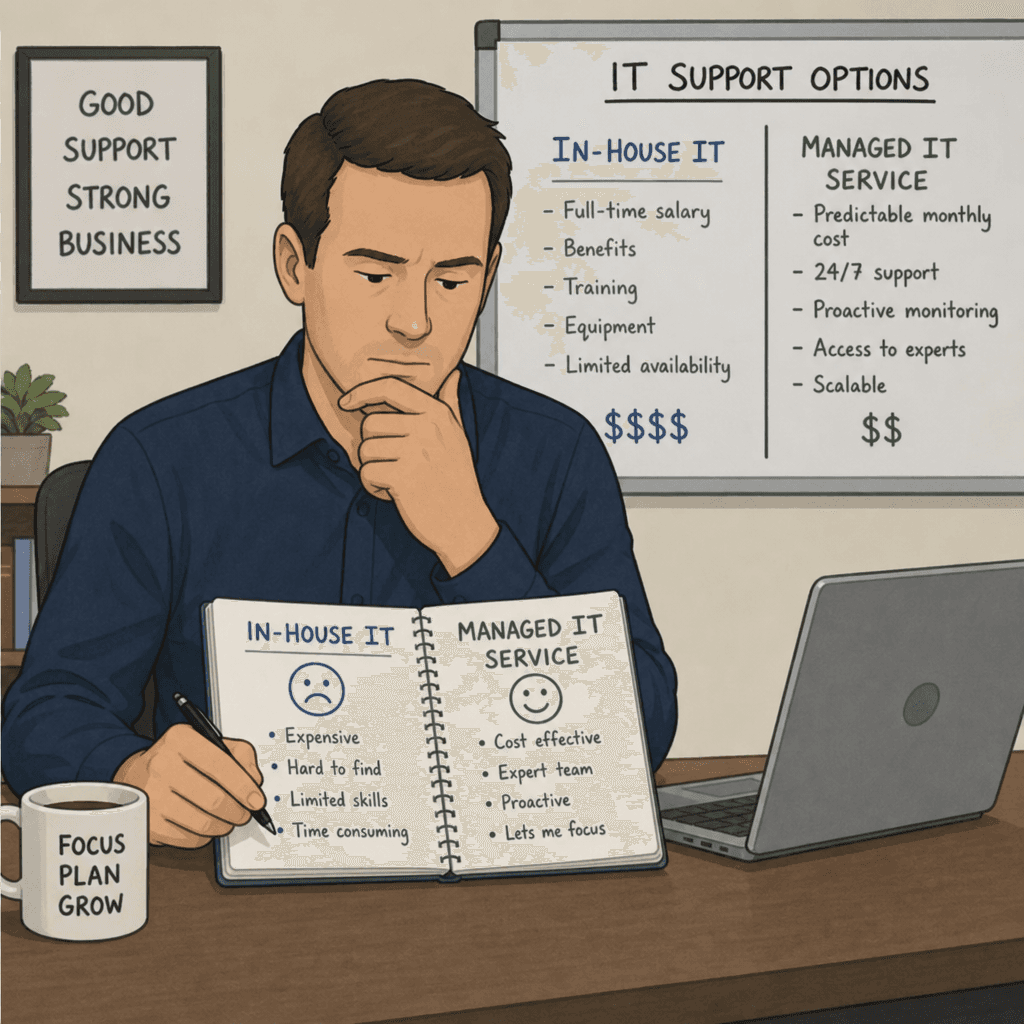
A practical IT outsourcing guide for decision-makers
A useful it outsourcing guide should start with business needs, not vendor labels. Before choosing a provider, define what you want outside support to accomplish. Are you trying to cut costs, improve response times, reduce security risk, expand coverage hours, complete a project, or free internal staff for strategic work?
Once the goal is clear, evaluate the work itself. If it is temporary, narrow, and easy to specify, traditional outsourcing may be enough. If it is ongoing, risk-sensitive, and connected to daily operations, managed services may be the stronger fit.
Use these questions to guide the decision:
How much internal IT expertise do you already have? A small team may need an MSP to provide structure and coverage. A mature internal department may only need targeted outsourcing.
How predictable is the workload? Recurring support needs often fit managed services. Short-term projects may fit outsourcing.
How much control do you need? If you need close alignment, regular reviews, and shared standards, an MSP model is usually better.
How sensitive is the data or environment? Higher security or compliance needs favor providers with ongoing accountability.
How fast is the business changing? Growth, acquisitions, remote expansion, and new systems often require proactive planning.
The best choice is rarely based on cost alone. A cheaper option can become expensive if it causes downtime, delays, rework, or unclear ownership. A more comprehensive service can also be wasteful if the business only needs a narrow deliverable.
Managed service provider vs recruitment process outsourcing
The phrase managed service provider vs recruitment process outsourcing can be confusing because both involve external partners, but they solve very different problems. A managed service provider usually refers to ongoing IT or operational service management. Recruitment process outsourcing, or RPO, refers to handing part or all of the hiring process to an external recruitment partner.
An MSP may manage devices, networks, help desk support, security tools, cloud systems, and technology operations. An RPO provider may manage candidate sourcing, screening, interview coordination, employer branding support, hiring workflows, or recruitment reporting. One focuses on technology service delivery. The other focuses on talent acquisition.
There can be overlap in large organizations that use multiple vendor models. For example, a company might use an MSP for IT infrastructure and an RPO partner for hiring technical staff. The key is not to confuse the categories. If your pain point is unreliable systems, security concerns, or support backlog, you are likely evaluating an MSP. If your pain point is filling roles faster or improving hiring operations, you are evaluating RPO.
Hybrid models can work well
Some companies do not need to choose between outsourcing and managed services completely. A hybrid approach can be practical when different needs require different levels of ownership.
For example, a business might use an MSP for core IT operations while outsourcing a one-time cloud migration, custom application build, or data cleanup project. Another company may keep strategic IT leadership in-house while using managed services for monitoring, backups, and help desk coverage.
A hybrid model works best when responsibilities are clearly documented. Each provider should know what they own, how issues are escalated, and who communicates with internal stakeholders. Without that clarity, hybrid support can create finger-pointing and delays.
Strong hybrid arrangements usually include:
A single internal owner for vendor coordination.
Written responsibilities for each provider.
Clear escalation paths for urgent issues.
Shared documentation standards.
Regular reviews of performance, risks, and upcoming changes.
Which option is right for your business?
Choose outsourcing when the work is specific, limited, and easy to separate from daily operations. Choose managed services when you need ongoing accountability, proactive support, predictable service levels, and a partner that understands your technology environment over time.
If your business is small and has no internal IT team, an MSP may provide the foundation you need to operate securely and consistently. If your business has a strong IT department but lacks capacity in one area, outsourcing a defined function may be more efficient. If you are growing quickly or facing increased security and compliance pressure, managed services can provide continuity while your internal capabilities mature.
The right external IT model should reduce confusion, not add another layer of complexity. Before signing an agreement, make sure scope, pricing, response expectations, reporting, security responsibilities, and exit terms are clear. A good provider should be able to explain exactly what is included, what is not included, and how success will be measured.
Final takeaway
Managed service providers and outsourcing vendors both help businesses access external expertise, but they are not interchangeable. Outsourcing is often best for defined tasks or temporary needs, while managed services are built for ongoing, proactive operational support. By understanding the difference between managed services and outsourcing, weighing outsourcing benefits against potential trade-offs, and matching the model to your actual business needs, you can choose support that improves reliability instead of simply shifting work elsewhere.